“Because your question searches for deeper meaning, I shall explain in simple words.” – Dante Alighieri
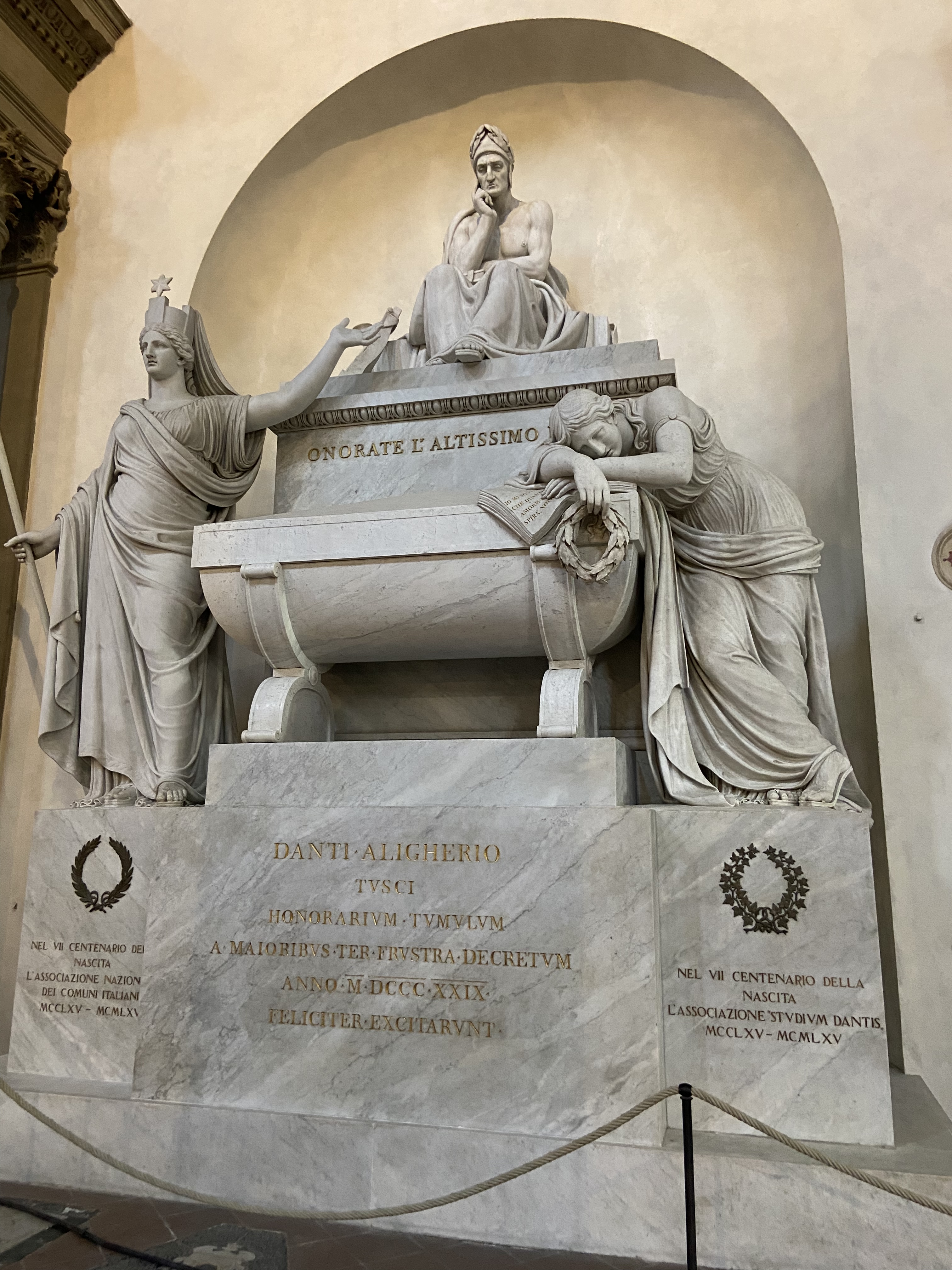
In the same main hall that houses the remains of Galileo, Michelangelo and Florence Nightengale in the Basilica of Santa Croce is a sculpture and remains of another, slightly less internationally infamous but greatly influential Italian. Dante Alighieri, a poet, writer and philosopher considered to be the “father of the Italian language” is shown with metaphorical Italy pointing at him and metaphorical literature weeping. The title of “father of the Italian language” was attached to him not only for the beauty of his prose and poems, but also because of the language he chose to write them in: Italian.
At the time, poems were written in Latin, restricting that material to the upper class who are educated enough to understand it. It was Dante’s belief, however, that this beauty should be accessible to all, and that there is beauty inherently existing in the Italian vernacular. The common Italian day to day language should therefore be placed at the heart of its citizen’s identity.
It was also his belief that “Beauty awakens the soul to act.” This was likely a driver to the decision to make the beauty of words more accessible. In doing so, he did more than just allow the mainstream Italian population to take in the beauty of poetry, but also ignite their will to act passionately, with a deepened love for their language and culture. This coincided with a period of internationalization in Florence, with an ever growing influence across the world.
It was a happen (and happy) chance that I was in Florence to learn this at all, having to take a detour on my way to Morocco for a dear friend’s wedding. I quickly booked an Airbnb near the church I was walking past, only to be completely floored on arrival when the host mentioned me it was the building where Dante had grown up. Later research showed that his building no longer existed, and I am not sure if the 4th floor “shabby chic studio” that I slept in was the exact style studio Dante slept in either, but it was true that it was on his road. I thought it worth mentioning because the studios on higher floors which helped a poet access the formational thoughts he would later share in an accessible language were physically inaccessible to a different type of person who cannot climb those stairs.
And that is the tricky part about accessibility: the ways in which a place or an experience needs to be improved to be accessible is situational.
Pair that fact with how technology products now drive almost every part of our lives universally, and accessibility becomes an almost overwhelming topic at face value to tackle. As an executive or product person, questions start to arise including – where do I start? How do I ensure all the bases of accessibility are managed? How do I manage the trade offs of an ever more competitive landscape and need for innovation on my roadmap with retroactively making past features more accessible? Is there a clear revenue add? How do I sell this time investment to my board of directors if the short term trade offs aren’t financially rewarding?
To not acknowledge these as valid concerns would be doing a disservice to the chances of a company taking the next steps on their accessibility journey, and it must be stressed that it is a journey. There are no silver bullets.
Luckily, industry governance and compliance looks to tackle overwhelming problems like these and give clear baseline critique as well as distilled next steps. Specifically, the Information Technology Industry Council (ITI) and the U.S. General Services Administration (GSA) created the Voluntary Product Accessibility Template (VPAT). In it, guidelines helping companies baseline themselves to a specific set of requirements within a compliance level are given. These requirements ensure that the benefits given to one type of person is also allowed for people who may not have been able to access them otherwise, including those who have trouble seeing, moving their hands, and hearing. It can range from app wide functionality of screen reading or content organization, to specific requirements which ensure that warnings are not closed until prompted by the user in case they are not able to absorb its content on time before it disappears. Much of these requirements would benefit everyone, but are especially important in making the app accessible at all to some.
Initially, the requirements within the standard a company is trying to achieve that are not being met should be taken as next steps, prioritised by effort and impact. On achieving that specific level of compliance, auditing and bridging the gaps of the next standard compliance level becomes the new next step. This gives guidelines and helps the formation of a cohesive short and longterm plan for companies.
This governance is now leaking into regulations within countries, with governments choosing to help (read lightly force) organizations incentivize the decision to become more accessible by disallowing sales of products which are not aiming to bridge this gap. This includes countries like France for example, which are helping push companies into making these strategies quickly.
As these regulations slowly start to feel like red tape, it is important to remember that « beauty awakens the soul to act ». As leaders and creators then, let us make sure we are taking the steps to allow for everyone to experience the beauty and function of our products, in the most accessible and presentable way possible for them.
For we are a better world when we unlock the global potential through beauty, awakening as many souls possible to act with passion. And let us give those beautiful souls all the product tools that are needed to thrive in this new world.
 Yaman’s Deep Dive